

Why Preventive Healthcare Needs an Orchestrator—Not More Providers
Preventive healthcare has long been positioned as the solution to rising chronic disease. The logic is simple: detect early, intervene sooner, manage continuously. Yet outcomes remain inconsistent.
The gap is not in awareness. It is in execution.
Healthcare today still operates in fragments. Diagnostics, consultations, medication, and lifestyle changes exist as separate steps—with no system ensuring they work together. In acute care, this may suffice. In chronic care, it becomes a structural weakness.
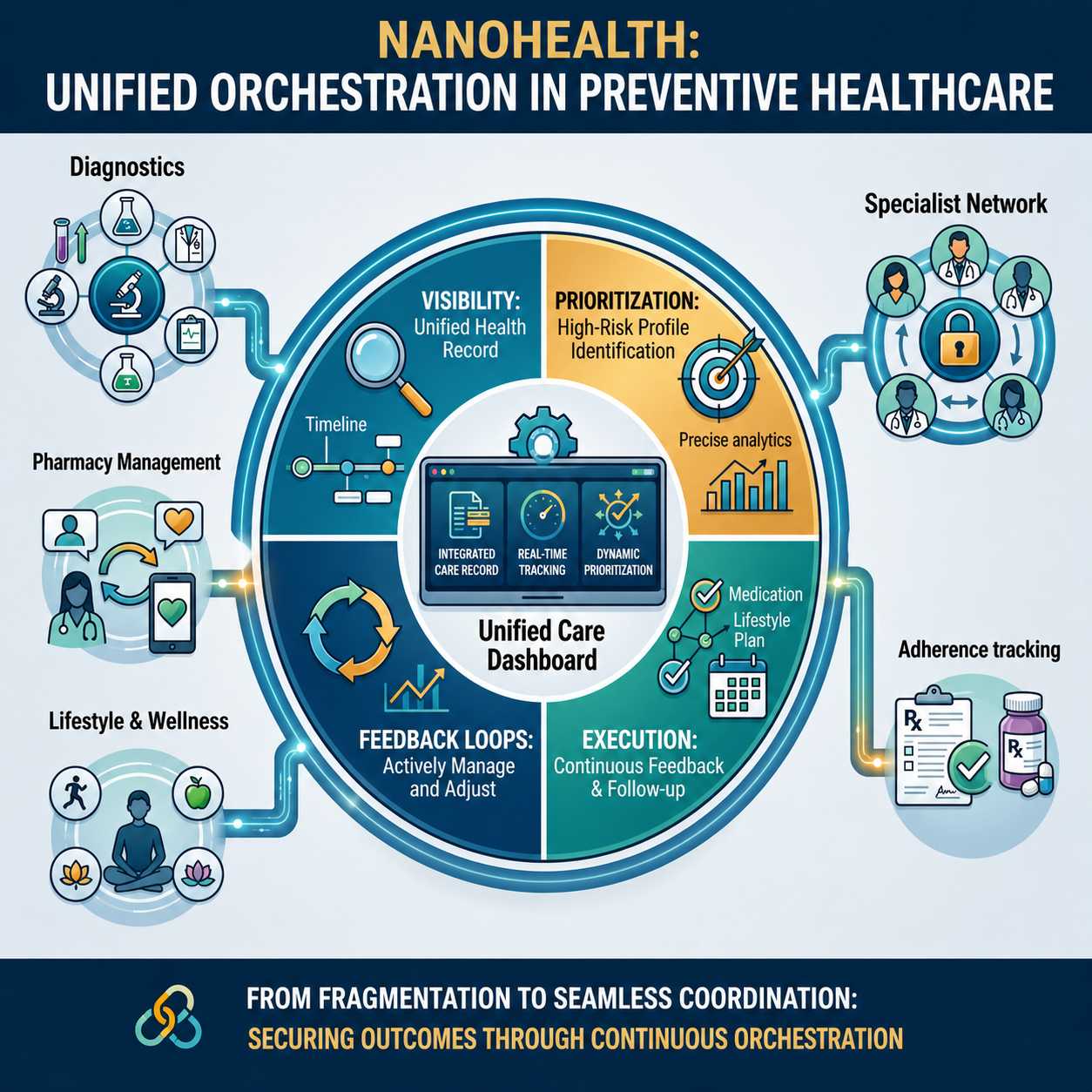
This is where NanoHealth plays a different role—not as another provider, but as an orchestrator that brings cohesion and continuity to preventive healthcare.
The Execution Gap
Preventive healthcare depends on a few fundamentals:
● Continuous monitoring
● Early risk identification
●Adherence to treatment
●Sustained lifestyle change
In reality, these break down quickly.
Data is collected but not acted upon.
Risks are identified but not prioritized.
Care plans are prescribed but not followed through.
The system informs—but does not manage
Fragmentation Is the Core Problem
A typical patient journey involves multiple touchpoints—labs, doctors, pharmacies—each functioning independently.
What’s missing:
● A unified view of health
● Continuous tracking of progress
●Timely intervention when risk escalates
This lack of coordination leads to delayed action and avoidable complications, especially in chronic conditions like diabetes and hypertension.
The Case for Orchestration
The solution is not more services, but better coordination.
Preventive healthcare needs a system that can:
●Integrate data across sources
●Track individuals continuously
●Prioritize risks dynamically
●Ensure follow-through on care
In operational terms, this is the role of a COO.
The Digital COO Model
NanoHealth approaches healthcare as an operational system—acting as a Digital COO that ensures execution, not just intent.
This plays out in four ways:
1. Visibility:A continuous, unified health record eliminates data silos.
2. Prioritization:High-risk individuals are identified early, enabling focused intervention.
3. Execution:Follow-ups, medication adherence, and lifestyle changes are actively managed.
4. Feedback Loops:Healthcare becomes a continuous cycle:
Track → Act → Improve → Repeat
From Monitoring to Management
Remote patient monitoring has expanded access to data—but data alone is not enough.
Without orchestration:
●Signals are missed
●Action is delayed
●Outcomes suffer
The real value lies in converting data into timely decisions and consistent execution.
Rethinking Chronic Care
Chronic disease management is not just clinical—it is operational.
It requires discipline, coordination, and continuity.
Without a system to manage these, even the best treatment plans fail.
Orchestration introduces that discipline—ensuring small risks are addressed before they become large problems.
Conclusion
Preventive healthcare doesn’t fail because we don’t know what to do.
It fails because no one ensures it gets done.
NanoHealth addresses this gap by acting as the orchestrator—the Digital COO of healthcare—bringing structure, accountability, and continuous management to health.
Because better outcomes don’t come from more touchpoints.
They come from running the system right.


